Architecture, Intelligence, and Enterprise Applications Explained
January 20, 2026


As artificial intelligence becomes central to enterprise strategy, two terms have emerged at the forefront of every technology discussion: AI Agents and Agentic AI. These terms are often used interchangeably — but they represent fundamentally different concepts with different architectural implications and business outcomes. Understanding the distinction is not just an academic exercise. For businesses investing in AI, clarity on these concepts defines strategy, tooling choices, and ROI expectations.
An AI Agent is a software system that:
AI Agents are purpose-built for a single workflow. Examples include:
Each of these agents performs one function well. They do not reason beyond their designated task boundary.
Agentic AI refers to AI systems capable of:
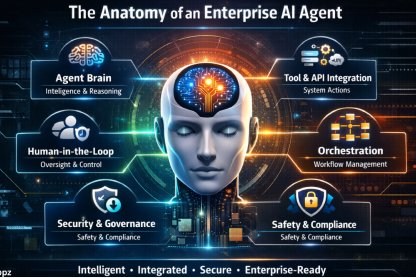
Unlike a single AI Agent, Agentic AI operates as an orchestrated intelligence — breaking a high-level goal into steps, using multiple tools or agents, and iterating until the objective is achieved.
Given the goal: "Analyse last quarter's sales data and prepare a competitor comparison report"
Memory architecture is one of the sharpest differentiators between the two:
This memory capability enables Agentic AI to learn from prior interactions, refine strategies, and operate with increasing effectiveness over time.
The right choice depends on the complexity of your business workflow:
Ezio Solutions helps enterprises assess workflow complexity and architect the right AI system — from purpose-built agents to fully orchestrated agentic frameworks.
Agentic AI is rapidly becoming the foundation of enterprise automation strategy. As models improve in reasoning, memory, and tool use, businesses will deploy agentic systems that:
Organisations that understand and act on this distinction today will hold a decisive competitive advantage tomorrow.
An AI Agent performs a single, defined task. Agentic AI orchestrates multiple agents and reasoning steps to autonomously complete complex, multi-step goals.
Yes. Agentic AI typically acts as an orchestrator that delegates specific tasks to individual AI Agents, combining their outputs to achieve a higher-level goal.
It depends on the application. Most enterprise deployments include human-in-the-loop checkpoints for critical decisions, while routine tasks run fully autonomously.
Memory allows Agentic AI to retain context across sessions, learn from prior actions, and improve performance over time — a capability single AI Agents lack.
Finance, healthcare, logistics, software development, and enterprise operations are leading adopters of Agentic AI for complex workflow automation.
Ezio Solutions provides end-to-end consulting, architecture design, development, and deployment of both AI Agent pipelines and fully orchestrated Agentic AI systems tailored to business goals.


 connect@eziosolutions.com
 +91 75300 93682
 Coimbatore, Tamilnadu.