
The Real Difference Every Business Should Understand
January 20, 2026

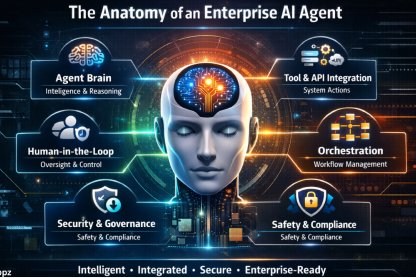
AI Agents are no longer a research concept — they are production-ready systems actively transforming how enterprises operate. From simple rule-following bots to complex reasoning systems capable of multi-step decision-making, AI Agents span a wide architectural spectrum. Understanding the different types of AI Agents and their capabilities is essential for any business looking to deploy AI effectively at scale.
An AI Agent is a system that:
The intelligence level, memory capability, and degree of autonomy differ significantly across agent types.
The most basic form of AI Agent. These agents:
Enterprise use: Basic rule-based chatbots, simple email auto-responders, threshold-based alert systems.
These agents maintain an internal model of the environment:
Enterprise use: Inventory monitoring systems, equipment state-tracking dashboards, logistics route management.
Goal-Based Agents reason about actions in relation to a defined objective:
Enterprise use: Scheduling optimisation, procurement planning agents, automated project milestone tracking.
These agents go beyond goals by optimising for the best outcome:
Enterprise use: Dynamic pricing engines, risk scoring models, resource allocation optimisers.
Learning Agents improve their performance through experience:
Enterprise use: Personalisation engines, fraud detection systems, predictive maintenance models, adaptive recommendation systems.
Multi-Agent Systems consist of multiple agents collaborating or competing to achieve goals:
Enterprise use: Supply chain coordination, autonomous software development pipelines, multi-department workflow orchestration.
The most advanced class of enterprise AI Agents, built on Large Language Models:
Enterprise use: Autonomous research agents, AI-powered business analysts, enterprise workflow automation, intelligent customer experience systems.
The right agent type depends on task complexity:
Ezio Solutions helps enterprises map business processes to the most effective agent architecture, ensuring performance, reliability, and measurable outcomes.
AI Agent architectures are rapidly evolving toward:
Organisations that invest in the right agent architecture today will build the intelligent enterprise infrastructure of tomorrow.
The main types are simple reflex agents, model-based agents, goal-based agents, utility-based agents, learning agents, multi-agent systems, and LLM-powered autonomous agents.
LLM-powered autonomous agents represent the most advanced class, combining reasoning, memory, tool use, and self-correction for complex, open-ended tasks.
Learning agents continuously improve their behaviour based on feedback and new data, whereas other agent types operate on fixed logic or pre-defined goals.
A Multi-Agent System consists of multiple AI Agents working together, each specialised in a subtask, to collectively complete complex, multi-step workflows.
For most enterprise workflows, LLM-powered agents or multi-agent systems provide the greatest flexibility, autonomy, and capability for end-to-end process automation.
Ezio Solutions analyses business workflows, selects the appropriate agent architecture, develops and trains the system, integrates it with enterprise tools, and provides ongoing optimisation.


 connect@eziosolutions.com
 +91 75300 93682
 Coimbatore, Tamilnadu.